Dien Bien Industrial Parks - Dien Bien Provinve
- Investor: Provincial Industrial Zone Management Board of Dien Bien Province
- Price: $25 usd/m2
- Area: 1.000 ha

DIEN BIEN, VIETNAM 2026
Vietnam’s Western Gateway for Heritage Tourism, Cross-Border Trade & Sustainable Frontier Investment
TTTFIC GLOBAL INVESTMENT PROFILE 2026 | PROFILE #09
Dien Bien is not a conventional industrial investment destination—and it should not be presented as one.
Its strategic value comes from a fundamentally different combination of assets: a unique frontier position bordering both Laos and China, the internationally recognized legacy of Dien Bien Phu, upgraded aviation infrastructure, expanding tourism demand, cross-border trade potential, agricultural and forestry resources, renewable-energy opportunities, and a relatively early-stage investment market.
For international investors, manufacturers, hospitality groups, infrastructure developers, logistics operators and institutional investors, Dien Bien should therefore be evaluated through a specialized frontier-investment lens rather than against Vietnam’s major manufacturing centers.
Global Heritage + Dual-Country Border Position + Aviation Connectivity + Cross-Border Trade + Agro-Forestry Resources + Green Energy + Frontier Investment Potential
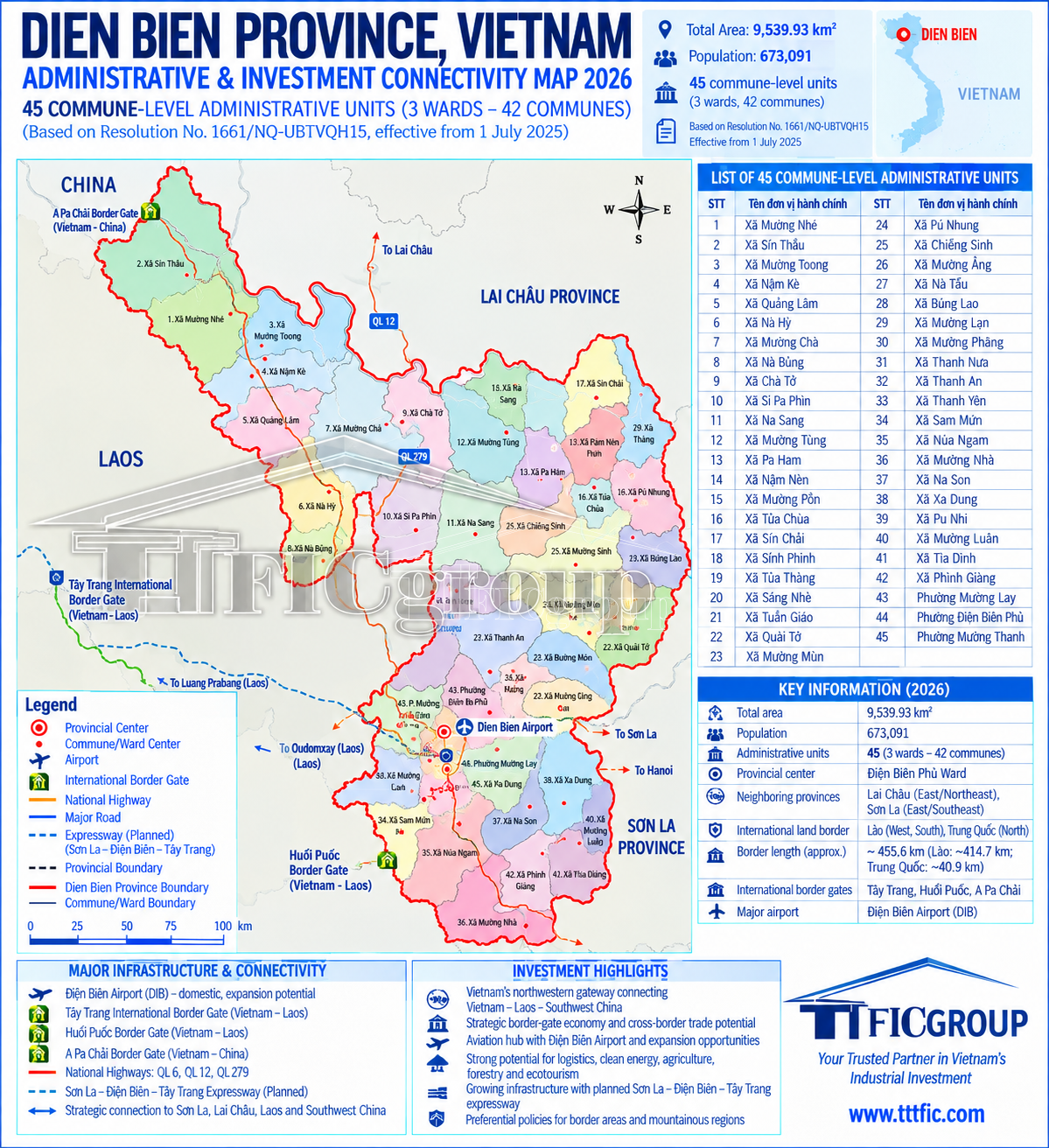
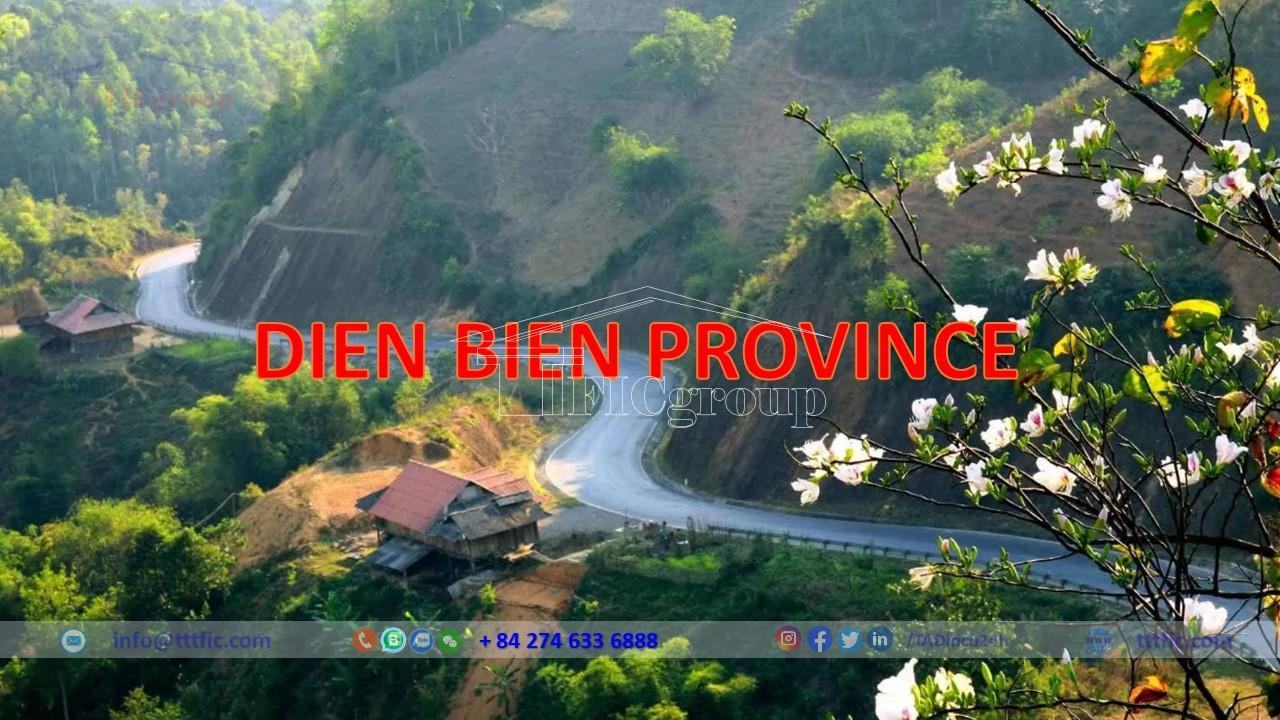
Located on Vietnam’s northwestern frontier, Dien Bien occupies approximately 9,540 km² and is the only Vietnamese province sharing land borders with both Laos and China.
Its international boundary extends for more than 455 km, including approximately 414.7 km with Laos and 40.9 km with China. The province borders Son La to the east and northeast, Lai Chau to the north, Yunnan Province of China to the northwest, and Laos to the west and southwest.
This geography gives Dien Bien a strategic role disproportionate to the present size of its economy.
Unlike Vietnam’s coastal manufacturing centers, Dien Bien has no seaport, limited industrial-park capacity and a relatively small manufacturing ecosystem. Those constraints matter and should be incorporated into any serious site-selection assessment.
But they do not define the province’s entire investment proposition.
Dien Bien combines five assets that are difficult to replicate elsewhere:
internationally recognized historical heritage;
direct borders with two countries;
a commercial airport capable of handling A320/A321-class aircraft;
significant mountain, agricultural and forestry resources;
and an early-stage tourism, border-trade and infrastructure investment environment.
The province’s investment story is therefore shifting from geographic remoteness toward selective connectivity.
In 2025, Dien Bien’s real GRDP increased by 7.34%, while GRDP at current prices reached approximately VND 35.66 trillion. Services made the largest contribution to overall economic growth, reinforcing the strategic importance of tourism, commerce and service-sector development.
For TTTFIC, the question is not:
“How can Dien Bien compete with Vietnam’s largest industrial provinces?”
The more relevant question is:
“Which investments become strategically compelling precisely because Dien Bien is different?”
Dien Bien retained its provincial identity during Vietnam’s recent provincial-level administrative restructuring. It was not merged with another province.
The major change occurred below the provincial level.
Under Resolution No. 1661/NQ-UBTVQH15, Dien Bien was reorganized into 45 commune-level administrative units, comprising:
42 communes
3 wards
The reorganized local administrations officially began operating on July 1, 2025.
This is an important distinction from the previous TTTFIC profile, which reflected Vietnam’s former district-based administrative structure.
Dien Bien lies approximately 500 km west of Hanoi and occupies Vietnam’s far northwestern frontier.
Its strategic border configuration is exceptional:
East / Northeast: Son La Province
North: Lai Chau Province
Northwest: Yunnan, China
West / Southwest: Laos
Official provincial information records a total international land border exceeding 455 km.
For investors, this creates a geography with three overlapping functions:
Vietnamese domestic market access
Laos-facing cross-border commerce
long-term China-facing border connectivity
This does not mean Dien Bien already operates as a major international logistics hub. It does mean that its infrastructure development has the potential to create a very different economic geography over time.
Dien Bien remains a relatively small economy within Vietnam, but recent growth demonstrates increasing activity across services, construction, industry and agriculture.
In 2025, GRDP at constant 2010 prices was estimated at approximately VND 17.55 trillion, representing real growth of 7.34%.
GRDP at current prices was approximately:
The current-price composition included approximately:
Agriculture, forestry & fisheries: VND 5.13 trillion
Industry & construction: VND 7.75 trillion
Services: VND 21.28 trillion
Product taxes less subsidies: VND 1.50 trillion
Most importantly, services contributed approximately 4.8 percentage points to the province’s overall 2025 growth—the largest contribution among the major economic sectors.
That composition provides an important signal.
Dien Bien’s future growth model is unlikely to be driven solely by factory development. Its competitive pathway is more likely to involve a combination of:
tourism + commerce + infrastructure + agriculture + energy + border economy + selective industry.
For international investors, the relatively small scale of the provincial economy should be understood as both a constraint and an indication of an earlier-stage market.
Dien Bien is not currently one of Vietnam’s major FDI destinations.
TTTFIC therefore does not recommend presenting the province as an established foreign-manufacturing cluster.
The absence of large FDI volumes itself provides useful investment intelligence.
It indicates that Dien Bien remains at an earlier stage of market development and that foreign investors should evaluate opportunities on a sector-specific basis, rather than relying on an already-established multinational manufacturing ecosystem.
The strongest international investment themes are more likely to emerge in:
Tourism & Hospitality
Heritage Destination Development
Cross-Border Trade & Logistics
Agro-Processing
Forestry & Biomass Value Chains
Renewable Energy
Airport-Linked Commercial Services
Specialty Agriculture
Selected Light Manufacturing
Infrastructure & Urban Services
This is a frontier-market proposition.
Potential returns must therefore be considered together with execution risks involving infrastructure, market depth, labor availability, project approvals, terrain, logistics and development timelines.
For sophisticated investors, that distinction is essential.
Industrial development is one area where accuracy is particularly important.
Dien Bien should not be marketed as though it already possesses a large industrial-park ecosystem.
Under the approved Dien Bien Provincial Planning for 2021–2030, with a vision to 2050, the industrial development plan identifies:
Tay Bac Industrial Park – approximately 55 hectares
The provincial planning framework also identifies a network of industrial clusters. The approved planning distinguishes existing industrial clusters from proposed new clusters, including facilities oriented toward agro-forestry processing, construction materials, mechanical services and other local or regional production activities.
This distinction matters:
PLANNED ≠ ESTABLISHED ≠ INFRASTRUCTURE-COMPLETE ≠ OPERATING
TTTFIC does not collapse those categories into a single “industrial park count.”
For large export manufacturers requiring hundreds of hectares of serviced industrial land, deep supplier networks, major container ports and mature logistics infrastructure, Dien Bien is generally not comparable with Vietnam’s principal industrial provinces.
However, there are more targeted opportunities.
The province may be relevant for projects involving:
The investment logic is therefore resource- and market-linked manufacturing, rather than industrial scale for its own sake.

One of the most important developments in Dien Bien’s modern investment landscape is the expansion of Dien Bien Airport.
Following its major upgrade, the airport now has a:
2,400-meter × 45-meter runway
and can accommodate aircraft including:
Airbus A320 / A321 and equivalent aircraft.
The passenger terminal is designed for approximately:
The airport resumed operations following expansion in December 2023.
For an isolated mountainous province, this is not simply an aviation upgrade.
It changes the investment equation.
Improved air accessibility can support:
international and domestic tourism
corporate travel
hospitality development
MICE and event tourism
investment missions
higher-value services
time-sensitive business connectivity
destination branding
Dien Bien remains geographically distant from Vietnam’s principal economic centers by road. Aviation therefore performs a strategically more important role here than in many provinces with dense expressway networks.
Another potentially transformative infrastructure project is the proposed Son La – Dien Bien – Tay Trang Border Gate Expressway.
Provincial authorities have been advancing preparatory work for the Dien Bien section, with the project intended to improve connectivity between the province, the wider Northwest and the Tay Trang international border corridor.
For investment analysis, its status must remain clear:
If implemented as planned, it could materially reduce one of Dien Bien’s largest structural disadvantages: long-distance road connectivity.
That would have implications for tourism, freight, agriculture, logistics, construction and investment accessibility.
Dien Bien’s border with Laos gives the province a natural role in cross-border commerce.
The Tay Trang International Border Gate provides an important gateway toward northern Laos and forms part of Dien Bien’s longer-term trade and transport strategy.
For investors, the opportunity is not simply the border gate itself.
It is the potential ecosystem surrounding it:
transportation
warehousing
agricultural trade
cold chain
distribution
customs-supporting services
border commerce
tourism flows
regional supply chains
As road connectivity improves, these functions could become increasingly relevant.
At Dien Bien’s northwestern frontier, the province has been working toward upgrading the A Pa Chai – Long Phu border opening into a bilateral border gate with China.
Authorities have also been preparing infrastructure and planning associated with the proposed A Pa Chai Border-Gate Economic Zone, together with improved road connectivity from National Highway 12.
Again, status matters.
TTTFIC treats this as an emerging strategic opportunity, not as a mature operating economic zone.
If fully developed, however, A Pa Chai could create an unusual investment proposition combining:
CHINA CONNECTIVITY + BORDER COMMERCE + TOURISM + LOGISTICS + REGIONAL SERVICES
Its significance is amplified by the broader geographic identity of the A Pa Chai area at Vietnam’s extreme western frontier.
THE ASSET THAT INDUSTRIAL STATISTICS CANNOT MEASURE
For Dien Bien, tourism should not be treated as a secondary section after industry.
It is one of the province’s principal investment stories.
In 2025, Dien Bien received more than:
with approximately:
Average visitor stay was estimated at approximately three days.
Across 2021–2025, the province received approximately 5.5 million visitors, generating more than VND 9.4 trillion in tourism revenue.
But the most important asset is not the current visitor count.
It is the name:
DIEN BIEN PHU
Few provincial destinations in Vietnam possess historical recognition of comparable international significance.
The Battle of Dien Bien Phu in 1954 was not simply a Vietnamese military event. It became a major turning point in twentieth-century history and the global process of decolonization.
That creates an asset no developer can manufacture:
Dien Bien’s challenge is therefore not creating an identity.
The identity already exists.
The investment challenge is converting that identity into a deeper, higher-value and more internationally accessible tourism economy.
Provincial authorities themselves have identified the development of a historical-cultural tourism ecosystem as a strategic direction, while recognizing that the economic value generated by Dien Bien’s globally recognized heritage remains below its potential.
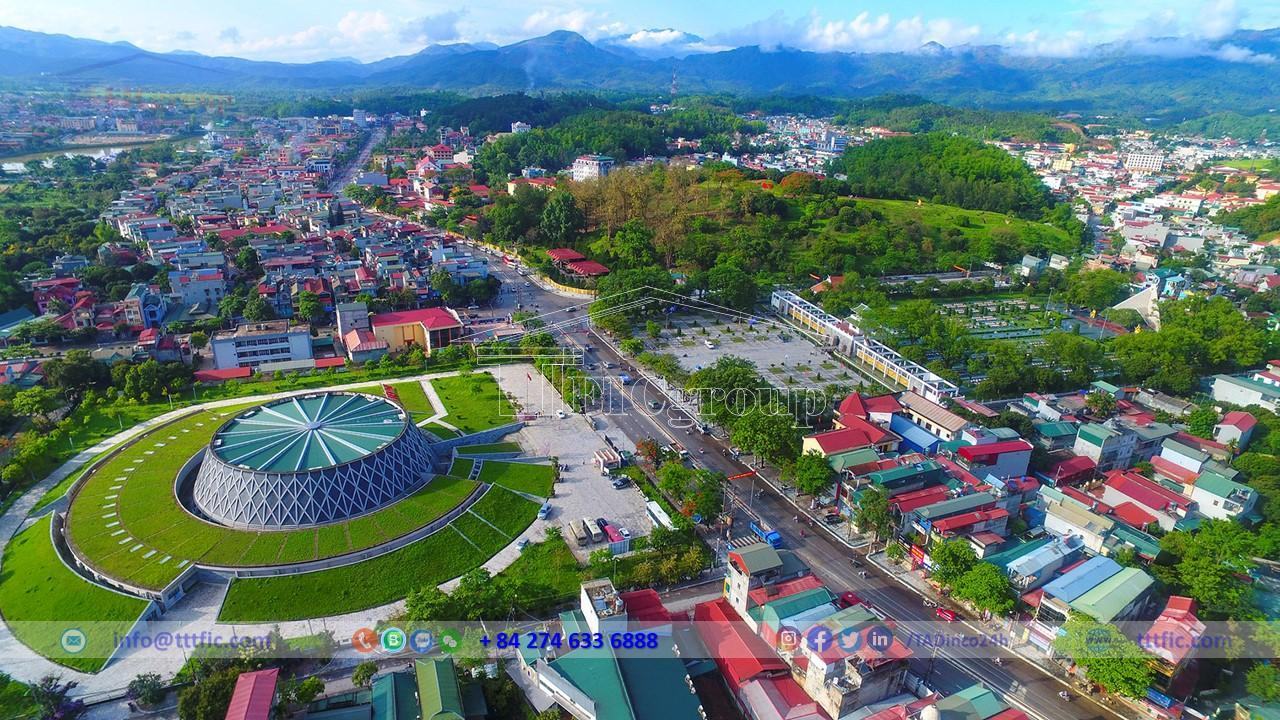
Major historical assets include the wider Dien Bien Phu battlefield and associated locations such as:
A1 Hill
Dien Bien Phu Historical Victory Museum
De Castries’ Command Bunker
Him Lam
Doc Lap
Muong Thanh Bridge
Muong Phang Campaign Headquarters
and the wider network of battlefield, memorial and historical sites.
The investment opportunity is not to commercialize history indiscriminately.
It is to build an internationally credible destination ecosystem around it.
That can include:
high-quality heritage hotels
boutique hospitality
historical interpretation
digital and immersive visitor experiences
international tour products
educational travel
research and academic tourism
MICE and commemorative events
cultural programming
destination retail
high-quality food and beverage
professional destination management
Dien Bien can potentially evolve from a place visitors “come to see” into a destination where visitors stay, learn, experience and spend.
That distinction has major economic implications.
Historical tourism is the anchor—but it should not be the entire product.
Dien Bien possesses mountain landscapes, lakes, valleys, agricultural areas and diverse ethnic cultures capable of supporting a much broader visitor economy.
The broad Muong Thanh landscape forms the geographic heart of the Dien Bien Phu area.
It provides a natural platform for combining:
history + rice landscape + local cuisine + ethnic culture + rural experience + hospitality.
For tourism investors, this integration is more valuable than treating each attraction separately.
The Pa Khoang–Muong Phang area provides opportunities for a different category of tourism:
eco-tourism
nature retreats
lakeside hospitality
wellness
outdoor recreation
highland experiences
low-density resorts
heritage-linked tourism circuits
This creates the potential to extend visitor stays beyond the battlefield heritage core.
Dien Bien is home to 19 ethnic groups, creating an exceptionally diverse cultural landscape. Recent official provincial materials report a population above 670,000 and continue to identify this multi-ethnic character as a defining feature of the province.
For investors, cultural tourism must be approached carefully.
Authenticity is the asset.
A sustainable model should therefore prioritize:
community participation
local employment
cultural preservation
traditional architecture
local food systems
handicrafts
responsible visitor management
benefit-sharing with host communities
The strongest tourism developments will not replace local identity.
They will make that identity economically sustainable.
Dien Bien’s mountain geography and valleys support a diverse agricultural base.
Rather than focusing solely on raw agricultural output, the investment opportunity lies increasingly in value creation after the farm gate.
Potential value chains include:
Muong Thanh is strongly associated with rice production and provides opportunities for premium branding, modern processing, packaging, food products and agricultural tourism.
Highland agricultural areas, particularly around established coffee-growing zones, create opportunities for better processing, branding, specialty products and direct-to-consumer value creation.
Long-cycle crops can support integrated investment models combining plantations, farmer partnerships, processing, packaging and market development.
Mountain ecosystems may support specialized agricultural products where commercial viability, cultivation standards and environmental conditions are demonstrated.
Dien Bien’s extensive forest resources create potential around sustainable forestry, certified timber value chains, biomass and forest-based economic models.
TTTFIC’s investment preference is clear:
The province creates a stronger investment proposition when agricultural and forestry resources are converted into higher-value products rather than simply sold as raw materials.
Dien Bien’s mountainous terrain and river systems provide conditions for hydropower and other renewable-energy development.
The approved provincial planning identifies energy as an important component of long-term infrastructure and economic development.
Potential investment themes include:
hydropower
solar energy
wind-resource assessment and development
biomass
energy infrastructure
and other renewable projects where technically, environmentally and commercially feasible.
However, TTTFIC applies an important investment-control principle:
Every energy opportunity must therefore be evaluated individually against:
land status;
power planning;
grid connection;
environmental requirements;
project approvals;
water-resource impacts;
community impacts;
construction access;
commercial viability.
This is particularly important in environmentally and socially sensitive mountain regions.
From a TTTFIC site-selection and investment-execution perspective, Dien Bien’s most credible opportunities fall into several specialized clusters.
Hotels, boutique accommodation, heritage-oriented hospitality, destination F&B, international tour products and experiential tourism.
Low-density resorts, nature retreats, lakeside hospitality, community-based tourism and mountain wellness products.
Warehousing, distribution, cold chain, transport services, agricultural logistics and border-related commercial facilities.
Rice, coffee, macadamia, fruit, specialty foods and other agricultural value chains.
Sustainable forest products, certified processing and biomass-related opportunities.
Selected hydropower and renewable projects subject to planning, grid, environmental and investment approvals.
Hospitality, transportation, retail, visitor services and other activities benefiting from improved aviation access.
Food processing, packaging, construction materials, regional consumer goods and resource-linked manufacturing.
Commercial services, destination infrastructure and selected urban development supporting the province’s transition toward a higher-value service economy.
Dien Bien should not be selected simply because industrial land may be less expensive than in Vietnam’s established manufacturing regions.
Low land cost alone does not compensate for logistics distance, smaller labor pools, limited supporting industries or lack of seaport access.
For an export manufacturer requiring:
large-scale serviced industrial land + dense suppliers + deep labor pool + container-port connectivity + mature logistics,
TTTFIC would normally evaluate other Vietnamese locations first.
That is precisely why Dien Bien requires a different investment thesis.
The province becomes compelling when the project itself benefits from what Dien Bien uniquely possesses.
A heritage hotel cannot relocate the Dien Bien Phu battlefield.
A border logistics project cannot relocate the Laos frontier.
A destination resort cannot reproduce Muong Thanh Valley somewhere else.
An agro-processing facility may gain value by locating close to its raw-material base.
A renewable-energy project follows the resource.
And an investor seeking an early position in an emerging frontier market may value precisely what a mature industrial province no longer offers:
This is Dien Bien’s real investment logic.
An institutional-quality investment profile must identify constraints as clearly as opportunities.
Investors evaluating Dien Bien should consider:
Mountainous Terrain
Construction, transportation and site development can be more complex than in lowland industrial regions.
Distance from Major Seaports
Dien Bien is not naturally optimized for container-intensive export manufacturing.
Limited Industrial Ecosystem
Supplier depth and industrial services remain considerably smaller than in Vietnam’s established manufacturing corridors.
Labor Scale
Large labor-intensive projects require careful workforce analysis.
Infrastructure Transition
Some strategically important roads, border facilities and economic-zone concepts remain planned or under development rather than operational.
Tourism Seasonality & Product Depth
Increasing visitor numbers alone do not guarantee high hotel occupancy, expenditure or investment returns.
Environmental & Social Sensitivity
Mountain, forest, hydropower and tourism projects require careful environmental and community assessment.
Border Investment Complexity
Cross-border opportunities depend on customs procedures, bilateral arrangements, infrastructure and actual trade flows—not geography alone.
These are not reasons to reject Dien Bien.
They are reasons to select projects carefully.
Dien Bien Phu provides an internationally recognized destination identity that cannot be replicated through conventional place marketing.
Dien Bien directly borders both Laos and China, creating a distinctive long-term trade and connectivity proposition.
Dien Bien Airport can accommodate A320/A321-class aircraft and has designed passenger capacity of approximately 500,000 passengers annually.
More than 1.45 million visitors were recorded in 2025, generating approximately VND 2.4 trillion in tourism receipts.
Tay Trang remains an important Laos-facing gateway, while A Pa Chai–Long Phu represents a developing China-facing connectivity opportunity.
The province provides opportunities to move agricultural and forest resources toward higher-value processing, branding and commercialization.
Mountain and river resources provide opportunities for appropriately planned renewable-energy investment.
Dien Bien remains substantially earlier in its investment cycle than Vietnam’s major industrial and tourism markets.
For the right investor, this can provide strategic positioning before infrastructure and destination development reach greater maturity.
TTTFIC Group approaches Dien Bien differently from a conventional property broker or promotional agency.
Our role begins with a fundamental question:
If the answer is yes, the next questions are:
Where?
For which investment model?
Under what legal and infrastructure conditions?
With what execution risks?
TTTFIC Group supports international investors across the investment lifecycle through:
Comparative province, corridor and site-selection analysis based on the investor’s actual operating model.
Identification and evaluation of industrial land, factories, logistics sites and commercial development opportunities.
Site and project screening for hotels, resorts, destination developments and tourism-related commercial investment.
Coordination for investment registration, enterprise establishment and related regulatory procedures.
Review of project status, land conditions, planning context, infrastructure and transaction considerations.
Evaluation of road, airport, border, utilities and logistics conditions affecting project feasibility.
Support for land, ready-built factory, built-to-suit and industrial property requirements where appropriate.
Structured engagement with relevant authorities, developers, landholders and project stakeholders.
Commercial coordination, due diligence workflow, documentation support and transaction management.
Support for investors requiring purpose-built facilities and project delivery solutions.
Ongoing assistance as investors move from market entry toward establishment and operations.
Dien Bien should not attempt to become another version of Vietnam’s coastal manufacturing provinces.
Its strongest future lies in developing what cannot easily be reproduced elsewhere.
The province possesses a rare combination:
HISTORY
TOURISM
AIRPORT
LAOS & CHINA FRONTIERS
AGRICULTURE
FORESTRY
ENERGY
CROSS-BORDER CONNECTIVITY
Individually, none of these automatically guarantees investment success.
Integrated intelligently, however, they create a distinctive frontier economy.
The upgraded airport can bring visitors and investors closer.
Historical heritage can create international demand.
Tourism can generate hospitality and service investment.
Agriculture can support processing.
Border infrastructure can expand commerce.
Energy resources can support new investment.
And future road connectivity can progressively reduce the economic cost of geographic isolation.
That is the transformation TTTFIC considers most important.
Dien Bien’s investment future should therefore not be measured by the number of industrial parks it can build.
It should be measured by how effectively the province converts its unique geography, globally recognized history, border position and natural resources into sustainable economic value.
TTTFIC GROUP
For international investors evaluating opportunities in Dien Bien Province or elsewhere in Vietnam, TTTFIC Group provides investment intelligence, location strategy, industrial real estate advisory, FDI establishment support, due diligence coordination and end-to-end transaction execution.
Explore Vietnam. Compare Locations. Invest with Intelligence.
TTTFIC VIETNAM INVESTMENT INTELLIGENCE PLATFORM 2026
34 Provinces & Cities. One Updated Investment Intelligence Platform.
Table of contents